← Daniel & Kristin's Collection
Greek — Stater
Aegina Sea Turtle Stater
525-480 BC
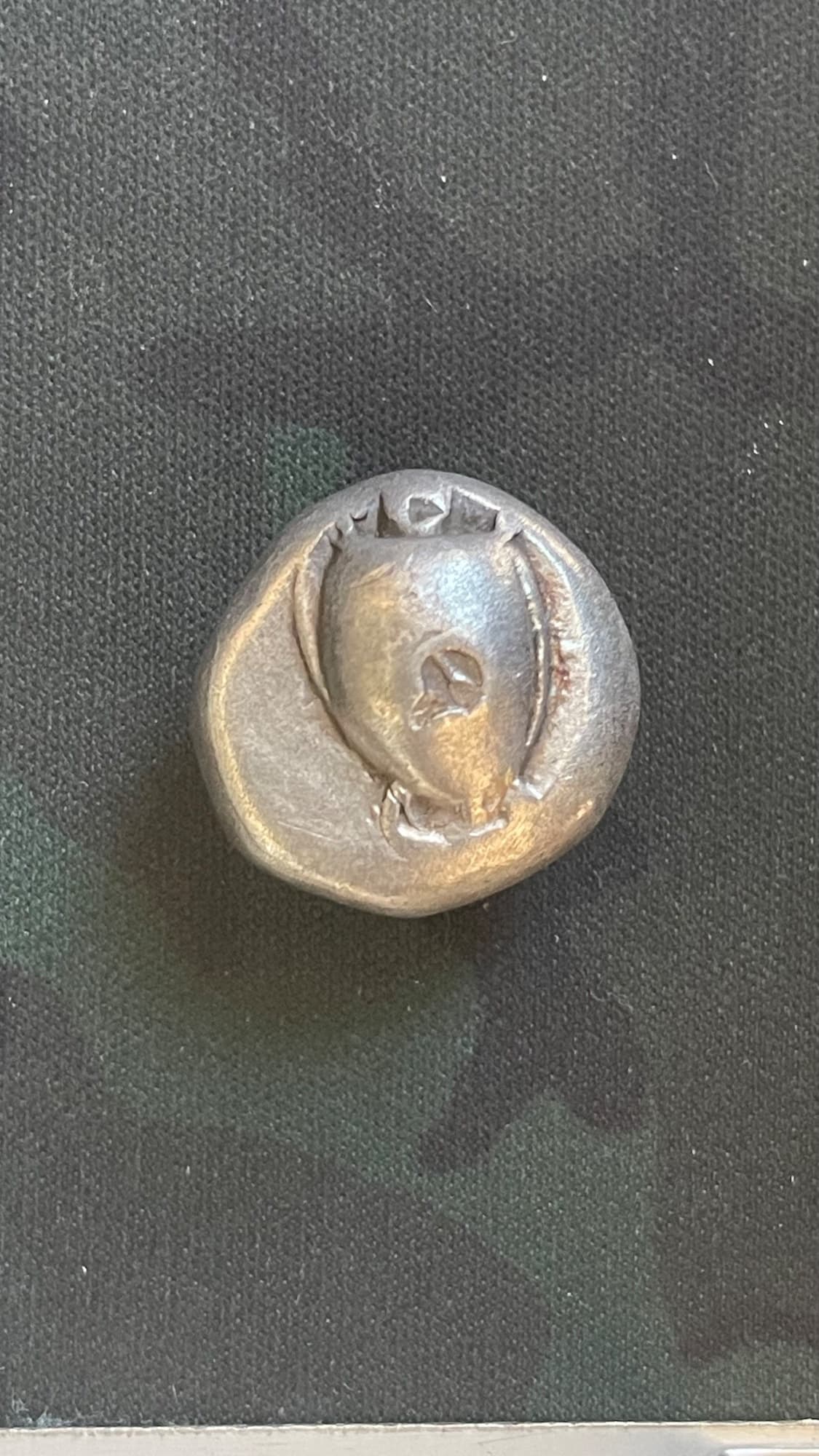
Obverse
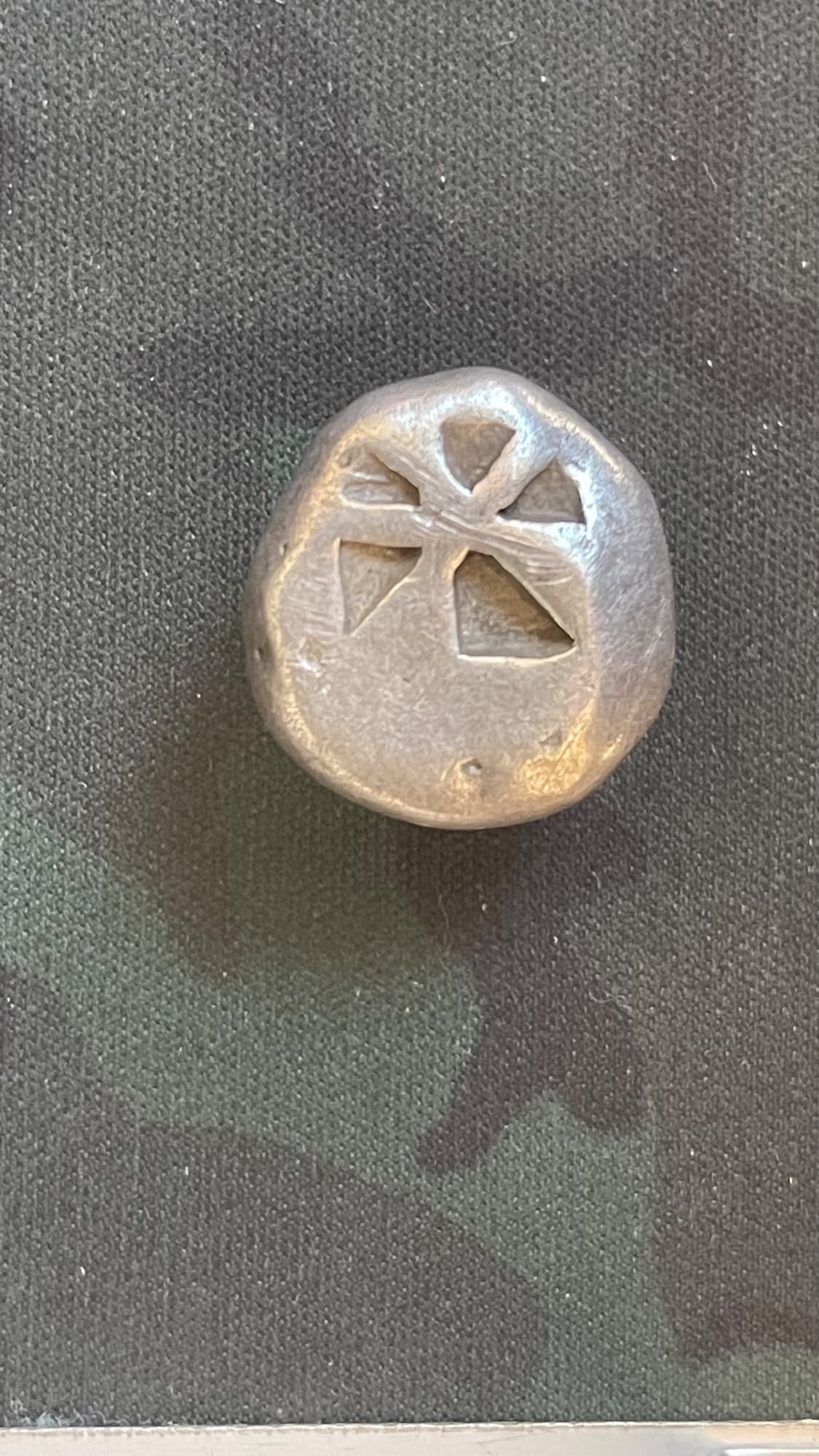
Reverse
The Story
Before Athens had its owls, before Rome had its denarii, a tiny island in the Saronic Gulf invented the idea of standardized coinage for the Western world. Aegina, just 87 square kilometers of rocky terrain visible from the Athenian Acropolis, became one of the first places in Europe to mint silver coins — around 580-570 BC, within a generation or two of the Lydian invention of coinage in Asia Minor. The turtle stater became the dollar of the ancient Mediterranean. Aeginetan merchants traded from Egypt to the Black Sea, and their silver coins — bearing the distinctive sea turtle and weighing a reliable ~12.2 grams — were accepted everywhere. The 'Aeginetic' weight standard spread across the Peloponnese, Crete, and much of central Greece. For nearly a century, if you wanted to do business in the Greek world, you used Aegina's turtles. This particular coin dates to the most dramatic period in Greek history: 525-480 BC. During these decades, the Persian Empire under Darius and then Xerxes launched two massive invasions of Greece. At the Battle of Salamis in 480 BC — the naval engagement that saved Greek civilization — Aeginetan warships fought with such ferocity that they were awarded the prize for valor above all other Greek contingents, including the Athenians. The banker's mark visible on the turtle's shell tells its own story. At some point in this coin's working life, a money-changer or merchant drove a small punch into the surface to verify it was solid silver all the way through, not a plated forgery. This was standard practice — a tiny scar that proves this coin was trusted, tested, and spent in the real economy of the ancient world. Aegina's dominance wouldn't last. Athens, enriched by its own silver mines at Laurion, began producing owl tetradrachms that gradually displaced the turtle. By 457 BC, Athens had conquered Aegina and reduced it to a subject state. The sea turtle on the coins was replaced by a land tortoise — a quiet symbol of a maritime empire grounded.
Historical Context
Greek Archaic Period — birth of European coinage
- •Aegina began minting coins around 580-570 BC, making these among the earliest coins in the Western world
- •This coin dates to the period spanning the Persian Wars — Marathon (490 BC) and Thermopylae/Salamis (480 BC)
- •Aeginetan sailors fought with distinction at the Battle of Salamis (480 BC), earning the prize for valor
- •Athens and Aegina were bitter rivals — Athens would eventually crush Aegina's independence in 457 BC
- •The banker's mark on the shell shows this coin was tested for silver content during its working life
Aegina's turtle staters were the first widely circulated coinage in Europe and the dominant trade currency of the Greek world before Athens rose to supremacy. This is among the most historically important coin types in Western civilization — the foundation stone of European monetary history.
Symbolism
Obverse
Sea turtle
Maritime power, commerce, and Aeginetan identity
The sea turtle was Aegina's civic badge — a perfect symbol for an island whose wealth came entirely from the sea. Sea turtles were abundant in the Saronic Gulf and represented Aegina's mastery of maritime trade. The earlier issues (like this one) show a sea turtle; after Athens defeated Aegina in 457 BC, the design changed to a land tortoise — possibly symbolizing the loss of naval supremacy.
Reverse
Incuse punch
A primitive minting technique predating artistic reverse designs
The reverse is simply the impression of the punch used to drive the blank into the obverse die. This 'incuse square' is characteristic of the earliest Greek coinage — the technology to align two dies hadn't yet been developed. The rough, geometric pattern is functional rather than decorative, yet it has its own raw beauty.
Design
Obverse
Sea turtle seen from above, detailed flippers extending to the rim
Reverse
Skewed incuse punch — a deep, irregular square depression hammered into the blank
What Could This Buy?
An Aeginetan stater at 12+ grams of silver was a substantial sum — roughly two weeks' wages for an unskilled laborer. It could buy a sheep, several days' provisions for a family, or a modest piece of furniture. This was not pocket change; it was serious money used for significant transactions and long-distance trade.
Worth Knowing
- ◈Aegina is so close to Athens (just 27 km) that Pericles called it 'the eyesore of the Piraeus' — an annoyingly visible rival
- ◈The shift from sea turtle to land tortoise after 457 BC may be ancient numismatic shade — Athens clipped Aegina's wings, so the turtle lost its sea
- ◈The Aeginetic weight standard (~12.2g) competed with the Attic standard (~17.2g for a tetradrachm) — two rival systems like metric vs. imperial
- ◈This coin was likely struck from silver mined on Siphnos, a nearby island whose mines were legendary in antiquity
- ◈The incuse reverse — that crude square punch — is actually what makes these coins so attractive to collectors: it's raw, ancient, and unmistakably archaic
Origin
Mint: Aegina
Role: First European city to mint coinage
A small but mighty island in the Saronic Gulf, visible from both Athens and the Peloponnese. Despite its tiny size (just 87 km²), Aegina was one of the great maritime trading powers of the Archaic Greek world. Its merchants sailed from Egypt to the Black Sea, and its silver staters became the most widely accepted currency in the Greek world before Athens rose to dominance. Aegina established the 'Aeginetic' weight standard (~12.2g for a stater) that was adopted across much of the Peloponnese and beyond.
Details
MaterialSilver
Weight12.07g
Diameter17.6mm x 18.6mm
PeriodLate Archaic
EraArchaic Greek
ReferenceHGC 6, 430-431
Also citedMeadows, Group IIb
GradeChoice VF
Additional Details
Condition NotesBanker's mark on turtle's shell; bright surfaces, light toning